Mon 2026.11.09
Coldframe: a decoy for fridge attacks
Today's pick: Coldframe
Coldframe is a product that poses as a supermarket refrigeration controller to draw in attackers. It records what they try.
It is today’s pick because you can see what attackers do after they log in.
- Found on
- Show HN
- Built with
- Python
The problem
According to the README, attackers broke into internet-connected refrigeration controllers in European supermarkets in 2026. They got in through default passwords and holes in unpatched firmware, then forced defrostA cycle that melts the frost on a refrigeration unit’s cooling coils. Cooling stops during the cycle, so the display case warms up. cycles. To watch attacks like these, you need a honeypotA decoy system made to look real so that attackers connect to it. It is used to record connections and attack attempts. that looks like an actual device.
Conpot is an open-source honeypot for industrial control systems. It imitates several industrial protocols, such as ModbusA protocol that industrial devices use to read and write settings and readings kept in numbered slots called registers. The protocol itself has no authentication.. A template decides which device it looks like. The default template holds Siemens identity strings. The repository has no template for a refrigeration controller.
How it solves it
Coldframe was posted on Hacker News as a Show HN on November 7, 2026. The maker, hedgerow-dev, says the fridge attacks prompted the project. The goal was to see what attackers try against a decoy that looks real.
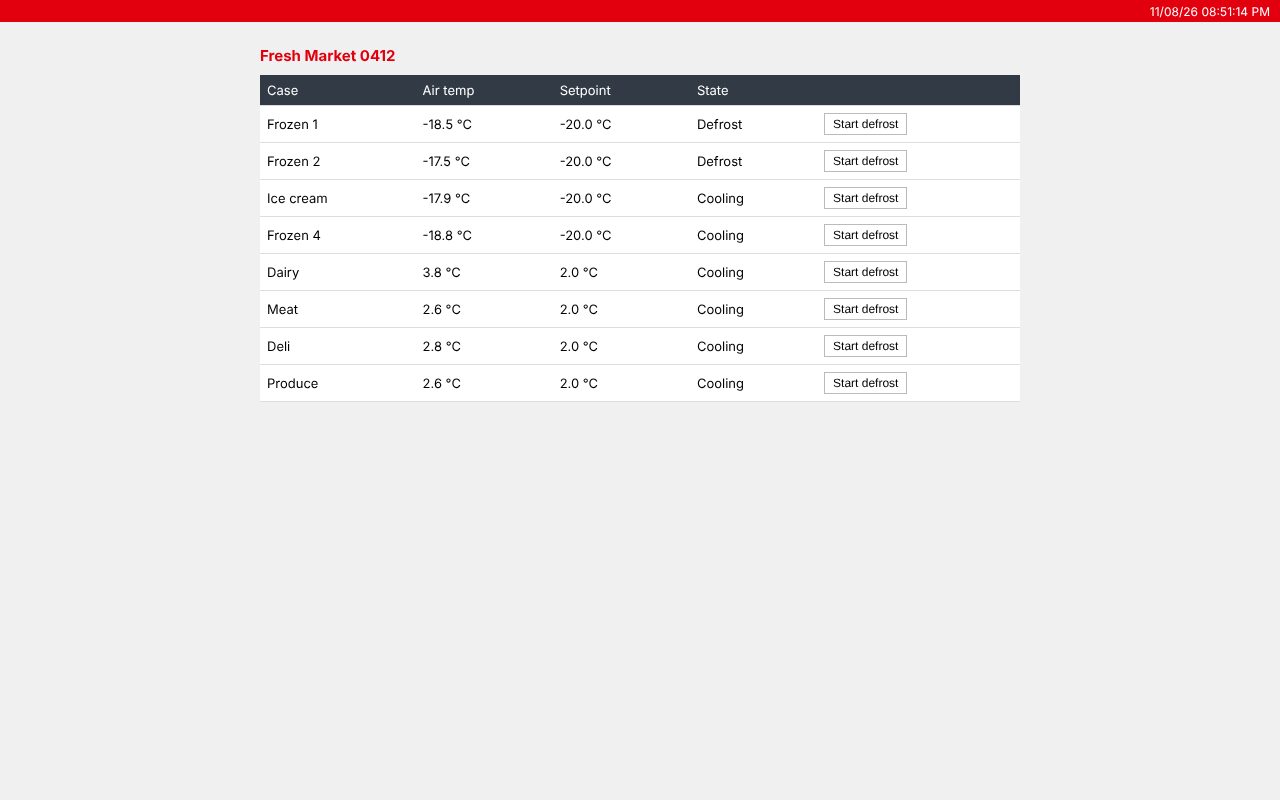
Coldframe imitates two refrigeration controllers: the Danfoss AK-SM 800A and the Copeland/Dixell XWEB EVO. The maker says Coldframe matches the header order, page titles, certificates and TLS versions of real devices that ShodanA search engine that finds devices connected to the internet and records their responses. It tells devices apart by headers and certificates. recorded. When an attacker logs in with a default password, a list of fake refrigerated cases appears. Actions like pressing the defrost button are accepted, but they only add a log entry. Requests that match what public exploit code sends are logged with the CVEA unique ID given to a publicly known security vulnerability, in the form CVE-year-number. number of that vulnerability. Both decoys can also run a Modbus service. It returns the temperatures and setpoints of the fake cases. It also logs writes to the register that starts a defrost. The README says real AK-SM 800A units use Modbus only to talk to their own case controllers. So the service is off by default. Turning it on also catches scanners that look for any kind of industrial device.
What is different
The first difference is how closely it imitates real devices. In Conpot, you write the device name and identity strings into a template. Coldframe imitates only two products, but it reproduces details such as header order, page size and certificates. The maker says these details came from Shodan’s records of real devices. Today the Dixell decoy’s first page was 8,202 bytes with no Server header, as the maker describes. The maker says Shodan does not flag either decoy as a honeypot. The tradeoff is that anyone who reads the repository can spot the decoy from its default responses. The README also says to change the strings, page layout and certificate name when you deploy.
The second difference is what the log tells you. In Coldframe’s log, the CVE number alone tells you which attack it was. The Conpot repository has no code that tags requests with CVE numbers. Coldframe lets an attacker log in with a default password or through a publicly known login bypass. So the log shows what the attacker does after logging in. The tradeoff is that there is little to do after login. According to the README, a logged-in attacker gets only a simple dashboard and a few XML commands. The rest of StoreView, the web app on Danfoss units, is not there. An attacker who looks for other features may notice the fake.
How it was built
- The repository has 13 commits, made between November 5 and 8, 2026. Every commit carries a Co-authored-by trailer for Claude Opus 5.5.
- The decoy is one file, honeypot.py (861 lines), and it uses only the Python standard library. The tests start both decoys locally and attack them.
- The maker says Coldframe builds on eppser/danfoss-ak-sm-decoy, an earlier decoy of the Danfoss device, and on public research by the security firms Synacktiv, Claroty and Ironhackers.
Running it
I ran the repository’s tests with Python 3.13.16. Then I started both decoys locally and tested them with curl, Playwright and my own Modbus requests. I ran the decoys with python3 instead of building the image. So I made the HTTPS certificate myself, with the same issuer and subject names that the Containerfile uses.
- Tests.
python3 -I test_honeypot.pyprintedOK: both personasafter 19 seconds. - Danfoss login. Logging in as Supervisor / 12345 returned a session token and a list of 8 refrigerated cases. After I pressed defrost on a case, the next read showed it as Defrost. The log recorded a control event.
- Attack requests. A file request with a path that climbs to parent directories got an empty reply. The log tagged it CVE-2023-25914. The Dixell decoy imitates the XWEB EVO. As the README says, it also tagged a request aimed at the XWEB Pro login bypass as CVE-2026-25085. With Modbus turned on in the Dixell decoy, I wrote 1 to the register that starts a defrost. The log recorded that write with a defrost flag.
- Connection limits. When I opened 80 connections from one address, 16 stayed open and the server closed the other 64 at once. A connection that sent one header line every 4 seconds to stay open was closed after 30.7 seconds. Coldframe served 1,000 requests for the login page, one after another, in 0.99 seconds. Its process memory was 23.1 MB before the requests and 23.3 MB after.
- Default values. I started two more Danfoss decoys with default settings. Both returned the same store name (Fresh Market 0412) and the same MAC address. Inside one decoy, the login page showed firmware version SVB501.0.168, and the XML API showed SVB501.000.139. According to code comments, the login page follows the screens of firmware 4.3.1. The same comments say the XML API reports firmware SVB501.000.139, a version from before 4.3.1 that still had the login bypass path. The code and README do not say why the two versions do not match.
$ python3 -I summary.py --hours 24 < dixell.jsonl
Fridge decoy, last 24h: 43 events from 1 IPs
  logins tried: 9 (accepted: 2)   exploit attempts: 2   modbus sources: 1   control writes: 1   DEFROST attempts: 1

Exploits:
      1  CVE-2026-25085 auth_mode bypass (XWEB Pro)
      1  CVE-2021-45420 command execution
Verdict
It works. Both the Danfoss and Dixell decoys logged attack attempts as the README says. But at 838b457, the default Danfoss decoy shows different firmware versions on the login page and in the XML API, so an attacker who compares them may suspect a fake. The maker says this was fixed in commit ebe05fb on November 10. It is worth trying if you want to see what fridge attackers do after logging in.
What to take away
- If you deploy a honeypot from a public repository, start by changing its hard-coded values. Coldframe’s store name and MAC address are in the code. No setting changes them.
- If you build a server that accepts connections, cap the number of connections per address and the lifetime of each connection. In Coldframe, the constant MAX_PER_IP caps connections per address, and CONN_DEADLINE caps connection lifetime.
Getting started
PERSONA=danfoss HTTP_PORT=8080 python3 -I honeypot.pypython3 -I test_honeypot.py
- You need
- Python 3. No external libraries or accounts are needed.
- Cost
- Free under the MIT license. Putting it on the internet needs a server, and the README says a $4 DigitalOcean server is enough.
Serving HTTPS needs a certificate file. The Containerfile creates a new certificate on every build.
Steps select 1 ran.
Progress
- Day 3Active
- Day 7Active
- Day 15Active
- Day 30Upcoming
- Day 90Upcoming
- Day 180Upcoming
- Day 365Upcoming
Latest check Day 15, Mon 2026.11.23
- Commits since launch
- 2 → 16
- Stars
- 56 → 78
- Latest release
- v0.1.0
- Last commit
- 2026.11.15
- HN points
- 272 → 291
3 commits, but nothing worth summarizing.