Sat 2026.11.21
erXos: an Erlang operating system
Today's pick: erXos
erXos is a product that runs even its drivers and file systems as Erlang processes. The website boots it in an emulator inside the browser.
It is today’s pick because a crashed driver starts again on its own. The rest of the system keeps running.
In four panels
1The problem
- Disk
- Driver in the Linux kernelOn an error, the kernel keeps running or stops
- Erlang runtimeRuns as one Linux process
- SupervisorRestarts only processes inside the Erlang program
Either way, an Erlang supervisor cannot restart a driver inside the kernel.
2How it works
- DiskA virtual disk in the emulator inside the browser
- MicrokernelFiasco, partly modified
- Storage domainDisk driver and the /data file system
- System domainRestarts a domain that has stopped
Ran today
erXos runs even its drivers as Erlang processes.
3What is different
BeforeerXos
Where drivers run
Inside the Linux kernelIn a protection domain outside the kernel
Processes the OS manages
The whole Erlang runtime is one Linux processEach Erlang process
4Running it
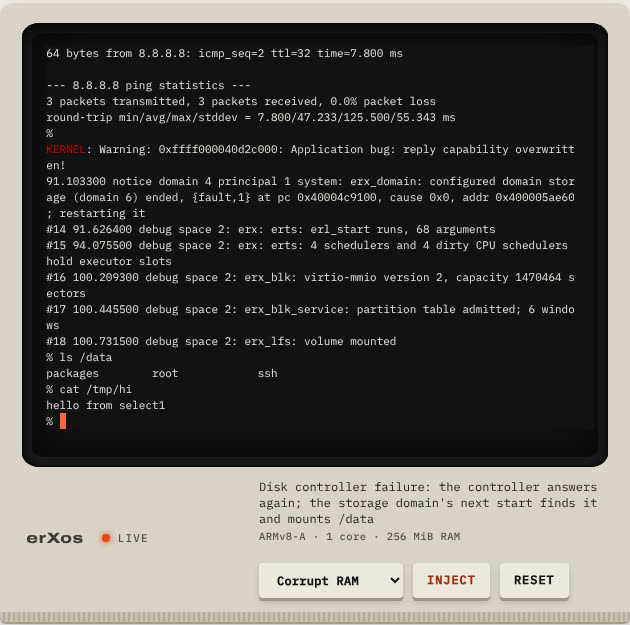
Disk controller failure injected. /data came back 9.6 s later on the emulator clock
The storage domain restarted and mounted /data again.
- Found on
- Show HN
- Built with
- Erlang/OTP, Fiasco, C, v64
The problem
Erlang survives failures by having a supervisorIn Erlang, a process that watches other processes. When one of them dies, the supervisor restarts it according to a fixed rule. restart a process when it dies. But when Erlang runs on Linux, this works only inside the Erlang program. The drivers for disks and network devices run inside the Linux kernel. The official Linux docs say that after a kernel error, the kernel either tries to continue or stops the system at once, depending on a setting. Either way, an Erlang supervisor cannot restart a driver inside the kernel.
How it solves it
The maker, Stanislav Sedov, posted erXos to Hacker News as a Show HN on November 20, 2026.
erXos runs even its drivers as Erlang processes. Its file systems, network stack and shell also run as Erlang processes on a microkernelAn OS design that keeps only the essentials in the kernel, such as address spaces, threads and messaging. Drivers and file systems run outside it.. The processes are grouped into protection domainIn erXos, a group of processes isolated from other groups. Each domain runs its own runtime, and messages between domains travel only over fixed connections., and each domain runs its own Erlang runtime. The runtimes share one set of process IDs and one message system, so they work as one Erlang system. When a driver dies, the system domain starts that driver’s domain again. The other domains keep running.
What is different
First, drivers run in a different place. Linux drivers run inside the kernel. erXos drivers run outside the kernel. So a driver crash does not stop the kernel.
Second, what counts as a process is different. Linux treats the whole Erlang runtime as one process. On Linux, ps shows only the one Erlang runtime process. On erXos, ps shows each Erlang process. The README says the Erlang shell can inspect kernel objectA resource the kernel creates and manages, such as a thread, an address space or a channel between processes.. A layer also implements part of POSIXA standard for the functions and commands that Unix-like systems give programs. A program that follows it can be recompiled and run on other Unix-like systems., and FreeBSD programs run on it once recompiled from source.
How it was built
- The repository has 2,522 commits from October 31 to November 19, 2026. All are by the maker. Of these, 2,271 have a Co-authored-by trailer for Claude Opus 5.5 and 98 for Claude Sonnet 5.5. The maker says on HN that AI coding agents made it possible to prototype an OS the maker had thought about for a long time.
- About 90% of the 31,084 files in the repository come from other projects such as the Fiasco microkernel and Erlang/OTP. The maker says the kernel is Fiasco with some changes.
Running it
I ran the browser demo on the website (https://erxos.org) 3 times, with Playwright in headless Chromium on Linux. The demo boots the QEMUAn open-source emulator that imitates a CPU and its devices in software, so an OS for another architecture can run. boot image in v64, an aarch64The 64-bit architecture of ARM processors. Most phones and single-board computers such as the Raspberry Pi use it. emulator inside the browser.
- Boot. The shell’s
%prompt appeared 67–126 seconds after I pressed Boot erXos. The 43 MB boot image downloaded in 1–5 seconds. The site says the kernel and shell come up in a few seconds. - Shell. I made /tmp/hi with
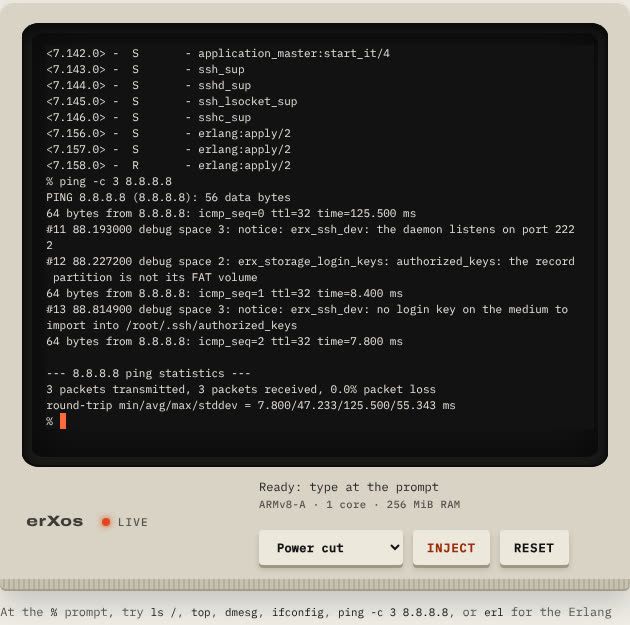
echoand read it withcat.pslisted 88 Erlang processes with Erlang PIDs such as<7.0.0>. - Network. All 3 requests from
ping -c 3 8.8.8.8got replies. As the site says, the replies came from a router emulated inside the page, not from 8.8.8.8. After boot, the browser made 0 network requests. - Disk controller failure. The storage domain runs the disk driver and the /data file system. I chose the controller failure in the demo’s fault menu. The storage domain ended with the exit reason
{fault,1}and started again./datawas mounted again 9.6 seconds after the domain ended by the emulator’s time, and 11.7 seconds after the fault in real time.ls /dataprinted the same list as before. I could still read/tmp/hi, a file I made in the RAM file system before the fault. - Dead disk. In another run I made the disk itself fail. The storage domain started again 5 times, and after the sixth exit it stayed down.
ls /dataprintedI/O error. I could still read/tmp/hi, and the shell kept working. This matches the description in the demo’s fault menu. - Kernel warning. Each time the storage domain ended, the kernel printed a one-line warning that contained
reply capability overwritten. The maker’s TODO.md says that this warning appears at every such fault and that nothing misbehaves.
91.103300 notice domain 4 principal 1 system: erx_domain: configured domain storage (domain 6) ended, {fault,1} at pc 0x40004c9100, cause 0x0, addr 0x400005ae60; restarting it
#14 91.626400 debug space 2: erx: erts: erl_start runs, 68 arguments
#18 100.731500 debug space 2: erx_lfs: volume mounted
% ls /data
packages	root		ssh
% cat /tmp/hi
hello from select1
Not checked
- Running on QEMU. Build the image with
make pack PLATFORM=qemu-virtin the repository and boot it in QEMU. - Inspecting kernel objects from the Erlang shell. Today I used only the command shell (rc). Open the Erlang shell with
erlin the demo and look at the kernel objects.
Verdict
It works. Only the storage domain restarted after an injected disk controller failure. But version 0.1 is a preview, and the maker advises running trusted code only. Boot took 1–2 minutes in headless Chromium. It is worth trying if you want to experiment with OS fault handling in Erlang.
What to take away
- If your system claims to survive failures, ship a button that injects them. In the erXos browser demo, I injected a disk controller failure and watched the storage domain recover.
- If your demo says that nothing you type leaves the machine, log its network requests after boot. The erXos demo made no network requests after boot.
Getting started
https://erxos.org 에서 Boot erXos 버튼% 프롬프트에서 ls /, ps, ping -c 3 8.8.8.8, erl
- You need
- A browser with WebAssembly support. It downloads a 43 MB boot image.
- On QEMU or a Raspberry Pi 4, use the image from the website or build one with make pack in the repository.
- Cost
- Free. erXos’s own code is under the BSD 2-Clause License, and the bundled Erlang/OTP is under Apache 2.0.
Version 0.1 is a preview. Its boot message says to run trusted code only.
Steps select 1 ran.
Progress
- Day 3Active
- Day 7Active
- Day 15Upcoming
- Day 30Upcoming
- Day 90Upcoming
- Day 180Upcoming
- Day 365Upcoming
Latest check Day 7, Fri 2026.11.27
- Commits since launch
- 2 → 1,283
- Stars
- 6 → 14
- Last commit
- 2026.11.26
- HN points
- 7 → 11
- The README and site now say that the Bluetooth UART (bleuart) ran on the Raspberry Pi 4.
- The Fiasco kernel now builds to identical output from any checkout, every time.
- The crash record now holds the state of each CPU when it stopped.