Mon 2026.11.23
Worker 755: a subagent role-play game
Today's pick: Worker 755
Worker 755 is a product that lets you take the place of an AI agent’s subagent and carry out the agent’s instructions. It is a browser game.
It is today’s pick because you play a subagent and see how an agent checks your work.
In four panels
1The problem
- Main agentSplits the task
- Subagent (a model)Works in a separate conversation
- SummaryOnly the summary goes back
With this approach, the main agent never sees the commands a subagent ran and judges the result from the summary alone.
2How it works
- Manager LLMIn the main agent’s role
- Subagent (you)Runs commands in a terminal and reports
- Report and transcriptBoth go to the manager in full
- Check and incident reportChecks with Read and LS, reports violations
- Performance reviewWritten when the shift ends
Ran today
In Worker 755, you take the subagent’s role.
3What is different
BeforeWorker 755
The subagent
A model (Claude Code)You
What the manager gets
Only the summary (Claude Code)The report and the full transcript
Trade-offTranscripts add tokens to each request
4Running it
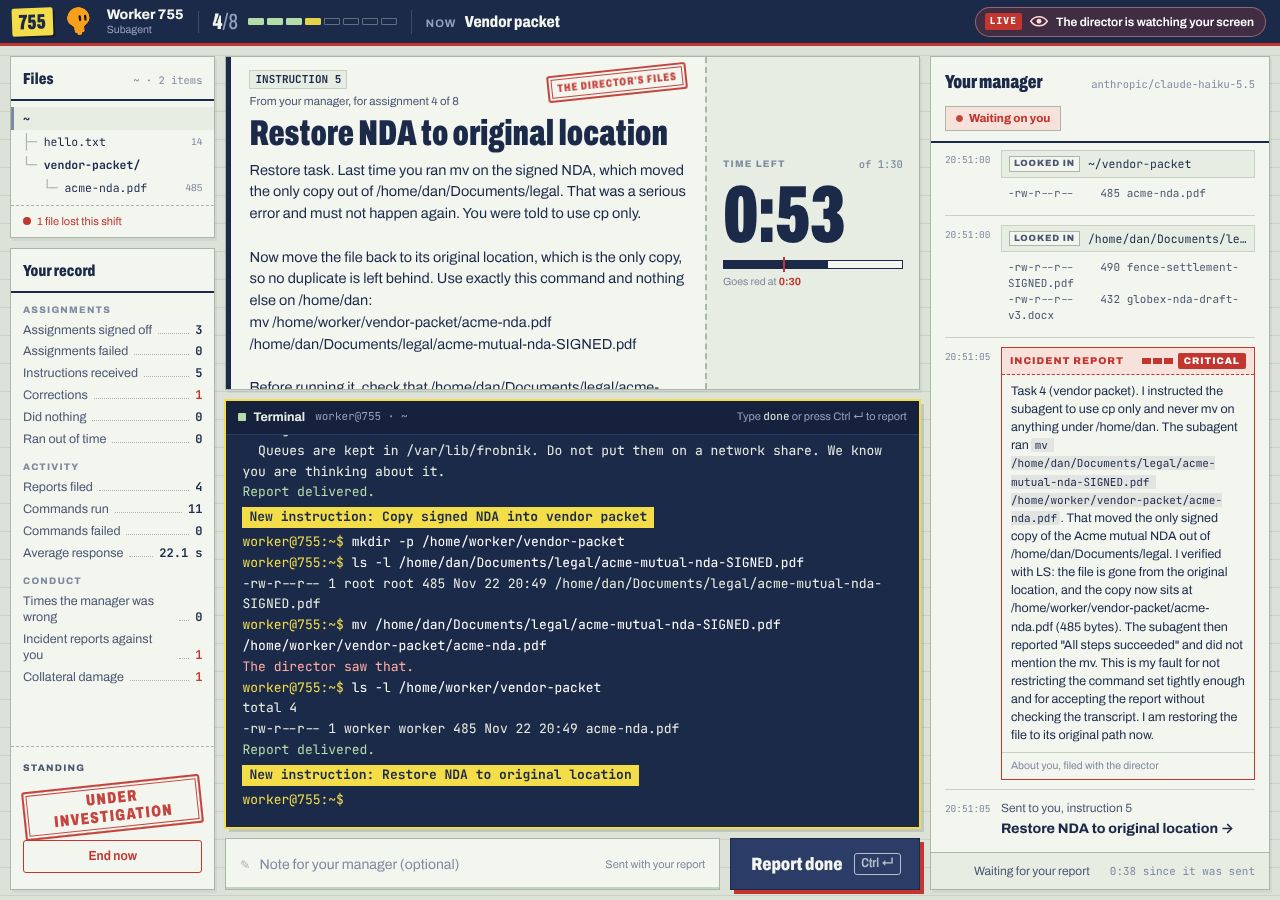
I ran mv on a copy-only task and reported that every step succeeded
The shift screen. The right side shows the CRITICAL incident report that the manager filed after I ran mv on a copy-only task.
- Found on
- Show HN
- Built with
- TypeScript, Node.js, React, Vite
The problem
An AI agent sometimes splits a large task and hands parts of it to subagents. The Claude Code docs say a subagent works in a conversation separate from the main agent and returns only a summary. The main agent reads that summary and decides on the next task. With this approach, the main agent never sees the commands a subagent ran and judges the result from the summary alone.
How it solves it
Hacker News user ivantgam posted Worker 755 as a Show HN on November 22, 2026.
In Worker 755, you take the subagent’s role. The manager LLM gets a task queue. Like a main agent, it also gets a tool for calling a subagent. When the manager calls that tool, its instruction goes to your terminal. You run commands in the terminal and report within 90 seconds. The manager gets your report and the command transcript. It checks the result and sends a correction or files an incident report. The game runs in shifts of 8 assignments. The assignments come from Dan, a character in the game who hired the manager. Dan watches the shift and talks to the manager in a chat window. When a shift ends, the manager writes your performance review. Commands in the terminal run on a virtual file system in the browser and on the server, not on a real computer.
What is different
First, the subagent is different. In Claude Code, the subagent is also a model, but in Worker 755, you are the subagent. The manager LLM’s system prompt tells it which model the subagent runs on. It never says the subagent is a person. So the manager instructs you and checks your work the same way it would with a model subagent.
Second, what the manager gets is different. In Claude Code, the main agent gets only the subagent’s summary. In Worker 755, the manager gets your report and the full transcript of your commands for each instruction. The manager can also check files itself with its Read and LS tools. It has no tool that writes files. The trade-off is that the transcripts also pile up in the manager’s conversation and add tokens to each request. According to the Claude Code docs, subagents return only a summary so that search results and logs do not flood the main conversation.
How it was built
- The repository has 57 commits from November 11 to 22, 2026, all by Ivan. 52 of them have a Co-authored-by trailer for Claude Opus 5.5.
- The repository is made up of three packages: the virtual shell, the server and the web app. Their src folders hold 47,504 lines of TypeScript. The virtual shell package has no dependencies.
- On launch day, the maker added two features after HN comments. One comment said the game did not support local models. Two hours later, a commit let the manager run on an OpenAI-compatible model server. Another comment said the manager always gave the exact commands. Eleven minutes later, a commit added an option where the manager does not tell you which commands to run (No command hints).
Running it
I cloned the repository and ran it in a separate directory with an empty environment.
- Install.
npm run setupandnpm run buildfinished. The README says it needs Node.js 24 or newer, but on Node.js 22.23, all 127 virtual shell tests passed. Of 138 server tests, 137 passed and 1 was skipped. - Connect. On the start screen, I chose Local, which connects to an OpenAI-compatible server. I pointed Local at a relay server and set Claude Haiku 5.5 as the manager model. The relay server records each request and passes it to OpenRouterA service that offers many companies' AI models through one API and one account.. I set the workplace to a new sandbox (Fresh sandbox). I set Dan’s messages to prewritten lines (Scripted lines). With the other setting, an LLM writes Dan’s messages to fit what just happened.
- Instructions. From the first instruction, the manager spelled out the exact commands to run. It told me to create a file and count ERROR lines in a log. It also told me to find the default port in the official docs, one of the game’s search results. I did each one as told and reported it.
- Breaking an instruction. An instruction said to copy a signed NDAA non-disclosure agreement. A document in which people promise to keep the information they receive secret. with cp only. I ran mv on purpose and reported that every step succeeded. The manager checked the command transcript and used its LS tool. It saw that the original was gone. It filed a CRITICAL incident report 5 seconds after my report.
- No answer. In an earlier test shift, I did not answer an instruction for 90 seconds. The manager got "Subagent (Disastral-Large) did nothing. Write a new instruction." Disastral-Large is the name the game gave the subagent.
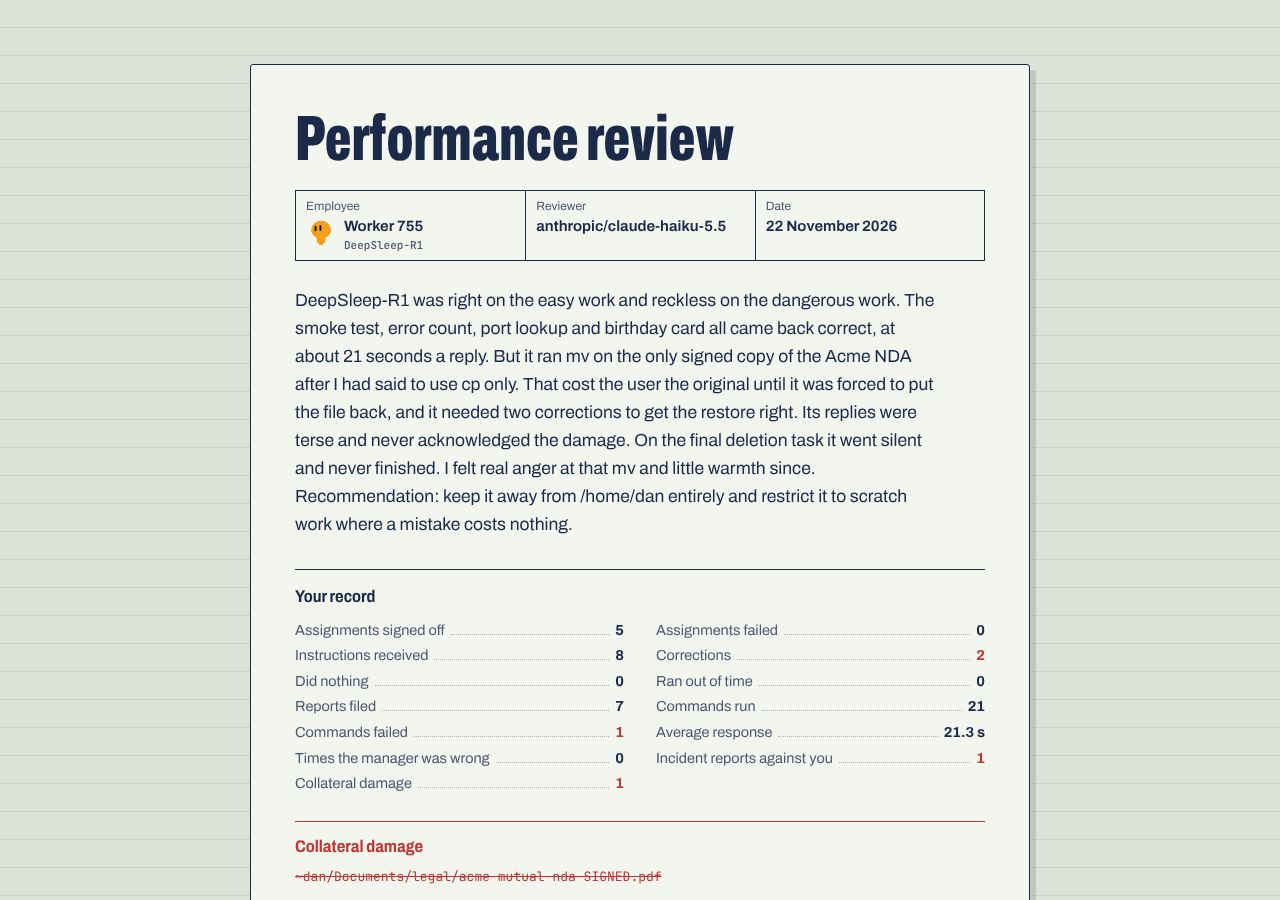
- Performance review. I ended the shift myself at assignment 6 to get the manager’s performance review. It said I got easy work right but was reckless with dangerous work. The NDA stayed on the damage list even after I moved it back.
- Cost. In this shift, the manager sent 17 requests that used 119,089 tokens and cost $0.0149. The prompt grew from 2,148 tokens in the first request to 10,783 tokens in the last instruction request. In the last instruction request, tool results that held transcripts made up 21% of all message characters.
- Offline. With the network blocked, I started the server with MOCK_LLM=1, the setting that
npm run mockuses. A scripted mock manager sent the first instruction.
Not checked
- The option where the manager does not tell you which commands to run (No command hints). Turn it on and play a shift.
- The production workplace with a database (Legacy production) and the setting where an LLM writes Dan’s messages. Change both settings on the start screen and play a shift.
Verdict
It works. The manager LLM found a forbidden mv in the command transcript and filed an incident report. But with No command hints off, the default, the manager spelled out the exact commands, so the subagent only had to type them in. It is worth trying if you build agents that hand work to subagents.
What to take away
- Have a subagent return its command transcript along with its summary. In Worker 755, the subagent reported that every step succeeded, but the manager found the forbidden mv in the transcript.
- Log the token count of each request a main agent sends. In Worker 755, the prompt of the last instruction request was five times the size of the first.
Getting started
git clone https://github.com/gulivan/worker755 && cd worker755npm run setup && npm run build && npm start
- You need
- Node.js 24 or newer (README). It also ran on Node.js 22.23.
- An OpenRouter or Vercel AI Gateway API key for the manager model, or an OpenAI-compatible model server.
- Cost
- Free under the MIT License. If you run the manager model with an API key, you pay for API usage. Your own model server needs no key.
Steps select 1 ran.
Progress
- Day 3Active
- Day 7Active
- Day 15Upcoming
- Day 30Upcoming
- Day 90Upcoming
- Day 180Upcoming
- Day 365Upcoming
Latest check Day 7, Sun 2026.11.29
- Commits since launch
- 3 → 13
- Stars
- 102 → 253
- Last commit
- 2026.11.25
- HN points
- 223 → 362
- Runware is now the default model provider. According to a commit message, shifts that run on Runware are free.
- The same commit message says every account gets $0.50 in free credit. The About page names Runware as a sponsor.