Wed 2026.11.11
HolyArrs: six media apps in one
Today's pick: HolyArrs
HolyArrs is a product that manages the movies, TV shows and music on a home media server in one app.
It is today’s pick because you no longer set up six apps separately and connect them.
- Found on
- Show HN
- Built with
- Go, SvelteKit
The problem
People who run a media server at home usually run several apps together. Sonarr handles TV shows, and Radarr handles movies. Lidarr handles music, and Bazarr handles subtitles. Prowlarr manages the search sites for downloads, and Seerr handles family members’ requests to add titles. The Sonarr and Radarr teams run the Servarr wiki. According to the wiki, Sonarr watches several RSS feeds to find and download new episodes. It also renames and sorts them.
According to the HolyArrs README, each app has its own login, port, update cycle and API key. You connect the apps by copying API keys from one to another. When an episode does not reach the library, you check all six apps to find out which one failed.
How it solves it
HolyArrs was posted on Hacker News as a Show HN on November 10, 2026. The maker, Luis, says the goal was to replace those six apps with one.
HolyArrs puts a server written in Go and a web interface built with SvelteKit into one executable. With one login and one port, you find, request and organize movies, TV shows and music. You connect a downloader and the search sites in the settings. HolyArrs gets titles, artwork and lists of popular titles from a metadata server that the maker runs.
What is different
The first difference is the number of apps. The usual setup runs six apps separately and connects them with API keys. HolyArrs handles the same work in one process, so there are no apps to connect. According to the README, HolyArrs can also import the shows, movies, folders and settings from the apps it replaces.
The second difference is the number of metadata servers. In the usual setup, each app gets its data from a different server. Sonarr uses skyhook.sonarr.tv, and Radarr uses api.radarr.video. Neither asks you for an API key to get this data. HolyArrs gets the data for movies, TV shows and music from one server the maker runs. Each install registers with it on its first lookup and gets a token. The tradeoff is that every lookup depends on that one server. If it stops, an install with the default settings cannot fetch new titles or artwork for movies, TV shows or music. The README says the maker pays for that server every month and sponsors cover the cost. If you put your own TMDB key in HOLYARRS_TMDB_KEY, movie and show lookups go straight to TMDB. HOLYARRS_TMDB_KEY is empty by default, because HolyArrs is designed to start without keys.
How it was built
- The repository has 15 commits from November 9 and 10, 2026. The first commit, 1.0.0, adds 3,232 files at once, so the earlier history is not in this repository. Each later commit is the next version, up to 1.0.14. No commit message has a Co-authored-by line.
- The server is 188,471 lines of Go, not counting tests, and has 1,073 test files. The web interface is 108,407 lines of Svelte and TypeScript.
- According to the README, the interface is translated into 16 languages.
Running it
I built 1.0.14 from source with Go 1.27.3 and Node.js 22. I made a 10-second test video with ffmpeg and put it in a movie folder. I used Playwright to control the web interface. I did not connect a downloader or any search sites.
- Build. Installing the web dependencies took 4.9 seconds. The web build took 51 seconds, and the Go build took 55 seconds. The executable is 50.7 MB. According to the README, the compressed Docker image is about 15 MB. To compare, I compressed the executable. It was 20.2 MB with gzip -9 and 15.7 MB with xz -9. I did not download the registry image, so I could not check the README figure.
- Startup. When I ran it as root, it exited with a message that it does not run as root outside a container. Still as root, when I set the user and group IDs in the PUID and PGID environment variables, it switched to that user and started.
- Setup. There were five steps: owner account, media folders, downloader, search sites and done. I could skip the downloader and search site steps. With both skipped, no screen asked for an API key before setup finished.
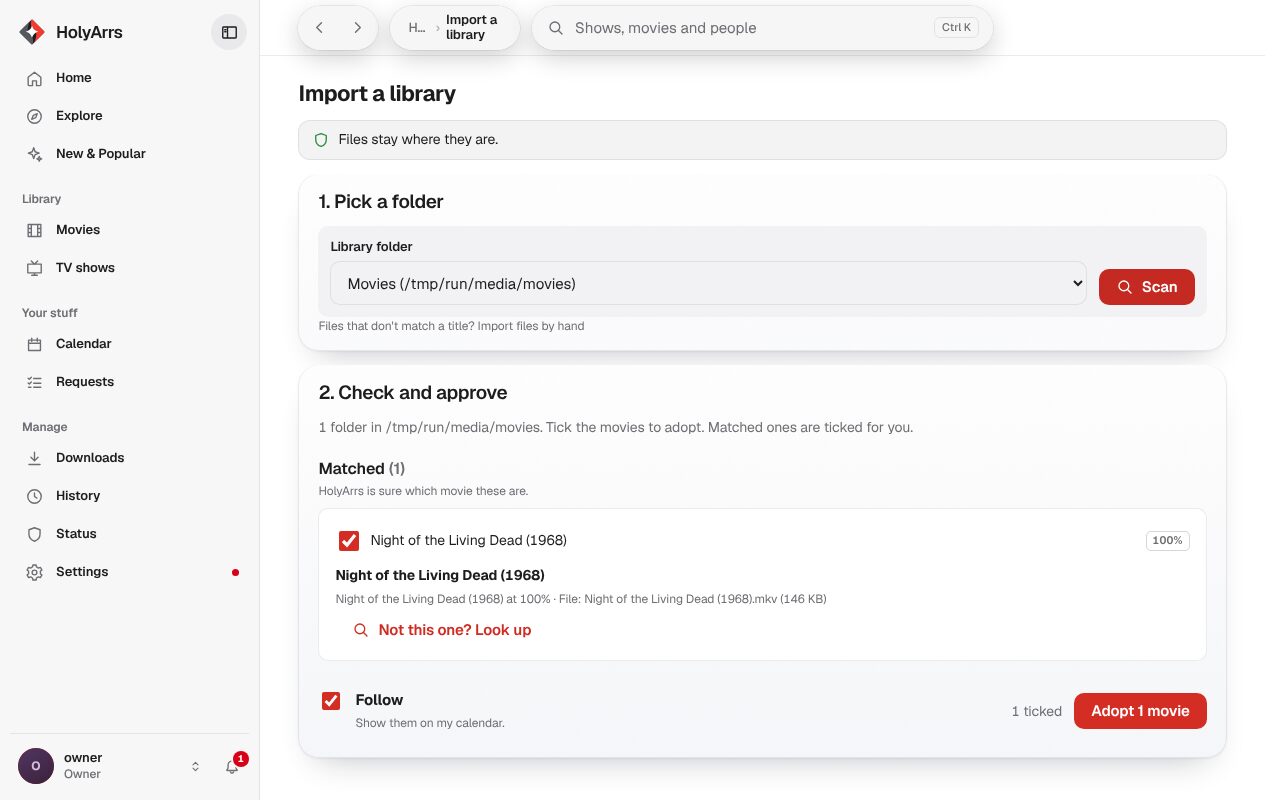
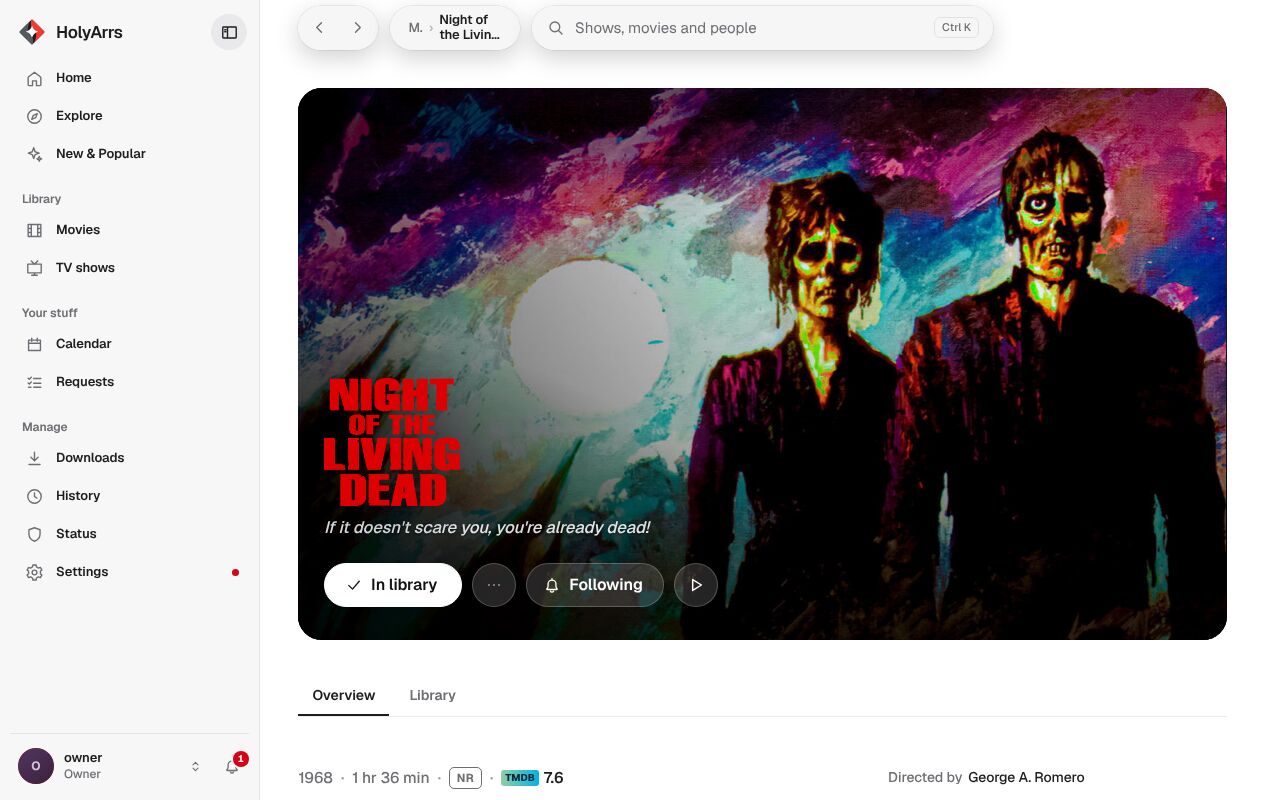
- Import. The test video was named Night of the Living Dead (1968).mkv. The import screen matched it to that movie by its file name and showed a 100% match. After the import, the file stayed in its original folder. The movie page showed the plot, director and cast. The trailer started on its own when the page opened.
- Playback. There was no button to play the imported test video. On Hacker News, the maker says HolyArrs does not play anything.
- Memory. With one movie in the library, the process used 130.6 MiB, and its peak since startup was 150.1 MiB. According to the README, it uses about 140 MiB with 10,000 titles. I added only one title, so I did not check that figure.
$ holyarrs -config /tmp/run/hconf -addr 127.0.0.1:16262
holyarrs: started as root outside a container: set PUID and PGID, or run HolyArrs as its own service user
$ PUID=1000 PGID=1000 holyarrs -config /tmp/run/hconf -addr 127.0.0.1:16262
holyarrs: running as 1000:1000, umask 0022
metadata: this install registered with the metadata server
Verdict
It works. I built it from source and imported the first movie without getting stuck. But HolyArrs does not play files, so you still need a media server such as Plex, Jellyfin or Emby to watch. It is worth trying if you manage your own movie and TV library at home.
What to take away
- If you want users of your self-hosted app to skip API keys, first decide who runs the server that holds the keys and who pays for it. For HolyArrs, the maker runs that server.
- If your server program handles files, make it refuse to run as root. HolyArrs does not start as root outside a container unless PUID and PGID are set.
Getting started
docker compose up -dhttp://your-server:6262 에서 소유자 계정 만들기
- You need
- Docker, or a source build with Go 1.27.3 and Node.js. You do not need to sign up for an outside service or get a metadata API key.
- Cost
- Free under AGPL-3.0.
It does not play files. You still need a media server such as Plex, Jellyfin or Emby to watch.
Steps select 1 ran.
Progress
- Day 3Active
- Day 7Active
- Day 15Active
- Day 30Upcoming
- Day 90Upcoming
- Day 180Upcoming
- Day 365Upcoming
Latest check Day 15, Wed 2026.11.25
- Commits since launch
- 17 → 129
- Stars
- 547 → 2,875
- Latest release
- 1.3.1
- Last commit
- 2026.11.24
- HN points
- 160 → 172
- Added a plugin system. Plugins run inside a sandbox. Tailscale is the first plugin (1.3.0).
- You can sign in with Trakt and see IMDb, Rotten Tomatoes and Metacritic scores (1.3.0).
- Added a hands-off mode that only sends the download to the download client and never touches the downloaded files (1.3.0).
- Titles on the streaming services you subscribe to are no longer downloaded (1.3.0).
- A failed connection test now names the exact problem (1.2.0).